
4 Ways to Make a Video Smaller without Blurry on Any Device

Many websites, email services, and messaging apps have file size limits. You can make a video smaller by compressing, lowering its resolution or bitrate, trimming unnecessary parts, or converting to a more efficient format (such as MP4 H.264/H.265). With the right method, you can shrink a video, keep good picture quality, and make this video much easier to share. See the steps below to reduce the video size without making it look blurry.
Guide List
What Makes a Video File Large Overall Solution to Make a Video Smaller Lower the Video Resolution Trim Unnecessary Video Footage Convert to a Lossy Video Format Troubleshoot Common Problems When Making Videos SmallerWhat Makes a Video File Large
Before you reduce video size, it helps to know what affects its size. Not every large video needs the same solution.
- Resolution: Higher resolutions (such as 4K) contain more pixels than 1080p or 720p. More pixels mean larger files.
- Video length: The longer the video is, the more storage it needs.
- Bitrate: A video with a higher bitrate has a larger file size.
- Frame rate: A video at 60FPS usually takes more space than a 30 FPS one.
- Codec: Modern video codecs like H.265 and AV1 usually compress videos more efficiently than H.264.
Overall Solution to Make a Video Smaller
If you often deal with larger videos, AnyRec Video Converter is your smart choice. You can compress, convert, edit, and enhance videos in one place. Whether you want to send a video through email, free up storage, or upload a large 4K video, you can reduce video file size within a few clicks.
Compress video to a desired file size or quality level.
Adjust video resolution to reduce storage usage.
Reduce video bitrate for a better balance between quality and size.
Convert video to 1000+ formats for smaller files.
Secure Download
Secure Download
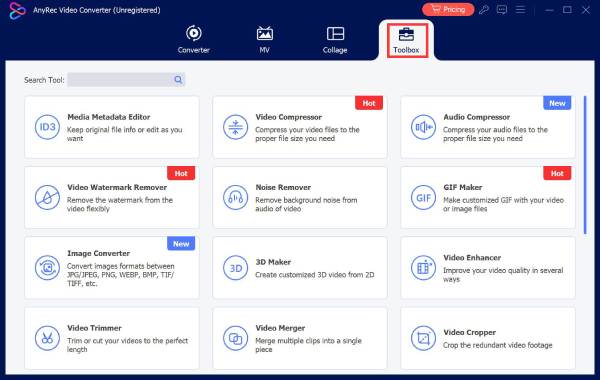
Step 1.Open AnyRec Video Converter. Go to the "Toolbox" section. Click the "Video Compressor" button.
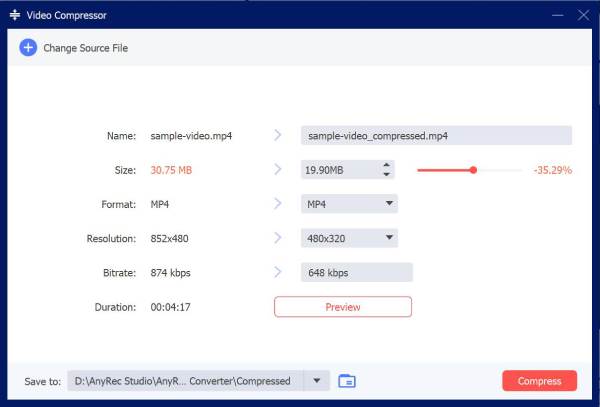
Step 2.Upload your video. Adjust the video size by setting the quality level or entering the number. Moreover, you can change the output video format, resolution, and bitrate to resize your video.
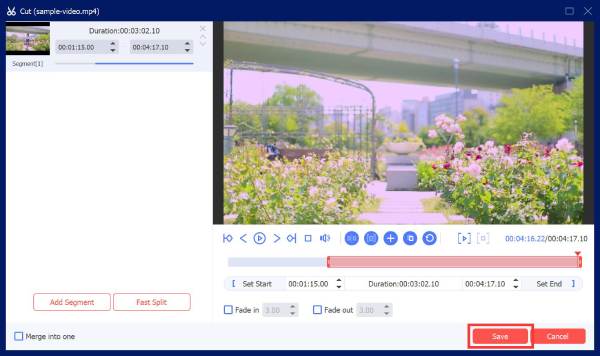
Step 3.Go back to the main interface. Click the "Edit" button. You can trim and crop a video to get a desired file size.
Lower the Video Resolution
If you don't need the highest video quality, you can reduce the video resolution to make the video smaller. Fewer pixels mean less data. So, your video file size can be smaller than before. Here are the common resolution changes:
4K to 1080p: It is great for saving storage while keeping the video sharp on most screens (especially on small screens).
1080p to 720p: A good option for sharing videos online or sending them through message apps.
Reducing the video resolution works best when people watch the video on a phone, tablet, or laptop. The video quality difference is often hard to notice. If your goal is faster uploads, easier sharing, or more storage, you can change video resolution to do so.
Trim Unnecessary Video Footage
If you don't mind deleting unwanted parts, you can trim the video to get a shorter video and a smaller file size. Here are some suggestions that you can consider for the video trimming. The video quality will not be influenced.
- Long intros that don't add much value.
- Blank or idle sections with no action.
- Mistakes or retakes that you don't want to keep.
- Ending credits if they are not necessary.
Convert to a Lossy Video Format
If your video is saved in an older or lossless format, you can convert the video to MP4 and other lossy formats to make the video smaller. Modern video codecs can compress videos more efficiently. Therefore, you can use less storage space while keeping a good visual quality.
MP4 (H.264): A widely supported format that works on almost all devices, websites, and media players.
MP4 (H.265/HEVC): A newer codec that usually creates smaller files than H.264 at similar quality. It is a good choice for large 1080p and 4K videos if your devices support it.
Troubleshoot Common Problems When Making Videos Smaller
Reducing the video size does not always go as planned. See the common complaints and solutions.
Video Looks Blurry
It is because the video bitrate and resolution are reduced too much. You can increase the bitrate and choose a higher resolution to fix it.
File Is Still Too Large
If your video is still bigger than expected after the compression, you can trim unwanted footage, compress the video again, convert the video to H.265 or other efficient codecs.
Upload Still Fails
If your video is still too large after compressing, trimming, cropping, and converting, you need to check the platform's maximum file size and upload requirements. If needed, you can compress videos again before uploading.
Conclusion
Large videos can slow down uploads, fill your storage, and make video sharing more difficult than it should be. Fortunately, there are several easy ways to reduce the video file size. You can lower the video resolution, remove unnecessary footage, compress the video, or switch to a more efficient codec. Even small changes can make a noticeable difference while keeping the video looking great.
If you regularly edit videos about screen recordings, phone videos, or 4K footage, AnyRec Video Converter can help you save time. It combines video compression, format conversion, trimming, and editing in a single program. Just import your video, choose the best option, and then export a smaller video file in a few clicks. Download AnyRec Video Converter to make video size reduction faster and easier.
Secure Download
Secure Download
About Our Author