
Hot

AnyRec Video Converter
120× faster video conversion and editing. No waiting.
Secure Download
How to Change and Convert to iPhone Video Format? (and More)

iPhones are very powerful when it comes to capturing cinematic footage, but they use advanced and highly compressed file formats. So, sharing videos from other devices to play on your iPhone may lead to compatibility headaches. What iPhone video format should you use? Today's guide shares the specific containers iPhones use, alongside changing the video format for iPhone directly, and how to convert any file into a perfectly optimized iPhone format. Continue below.
Guide List
What Video Format Does iPhone Use How to Change iPhone Video Format How to Convert Video to iPhone Format Fix Common Problems of iPhone Video FormatsWhat Video Format Does iPhone Use
When you record on your iPhone, the device works behind the scenes to have a perfect balance of visual quality and file sizes. By default, iPhones record videos using the following configuration:
- • Container Format: MOV
- • Codec: HEVC (H.265) or H.264
To understand more about how your iPhone manages video data, here's a breakdown of the specific containers and video compression standards that Apple uses.
MOV. It is a multimedia container made by Apple Inc. It holds the video track, audio tracks, and metadata together in a single file.
HEVC (H.265). It stands for High Efficiency Video Coding, the default video compression standard for modern iPhones. Your iPhone automatically uses HEVC when you capture in heavy modes like 4K at 60 fps.
H.264. This is an older video compression standard that Apple refers to as Most Compatible in the iOS settings. While H.264 takes up more storage space, it can be played or edited on almost any device, browser, or operating system.
How to Change iPhone Video Format
Building on how iOS handles your footage, especially on iPhone video format, you can easily customize these settings depending on your current needs. Adjusting it takes only a few taps, so here's how to change video format on iPhone via iOS settings, updating your recording preferences.
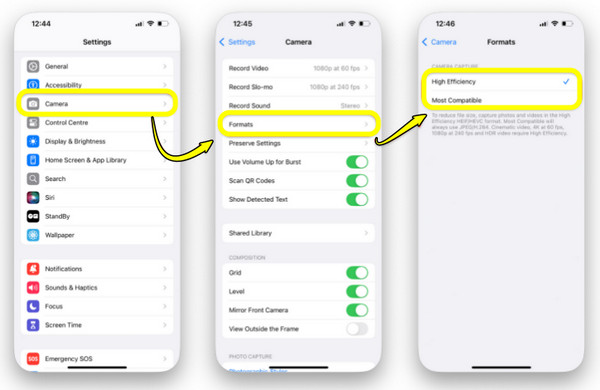
Step 1.Launch the Settings app on your iPhone. Scroll down through the main list until you reach the apps block, then tap on "Camera".
Step 2.Tap on "Formats", which is found at the very top of the Camera settings screen. From the "Camera Capture: section, choose your desired settings:
- • High Efficiency. Lock your iPhone into the HEVC (H.265) codec.
- • Most Compatible. This forces your device to use the H.264 codec, maximizing compatibility across non-Apple devices.
How to Convert Video to iPhone Format
While modern iPhones capture stunning video, getting clips from other devices, especially from Android phones, to play back smoothly is sometimes a challenge. If you have an unsupported video file, converting it to an iPhone video format with AnyRec Video Converter is the easiest way to have smooth mobile playback and editing. Available for both Windows and Mac, this robust software effortlessly optimizes any video file into a format tailored for your iPhone without degrading a single pixel of clarity. Used with advanced GPU acceleration, it completes the conversion in just the perfect time.
Seamlessly optimize videos into native iPhone video format on PC and Mac.
Handles whole folders of video files at once while keeping the original quality.
Utilizes your computer's graphics card to deliver lightning-fast conversion speed.
Can trim, crop, or polish your video before saving it for your iPhone.
Secure Download
Secure Download
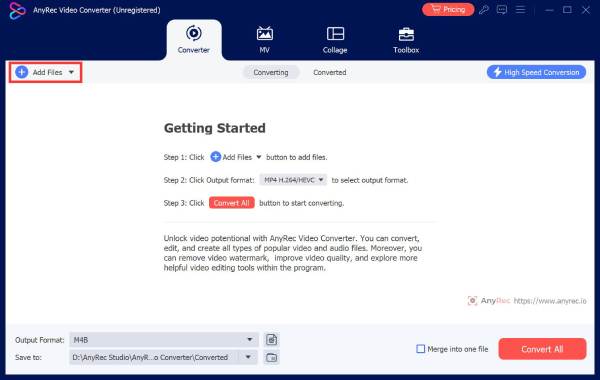
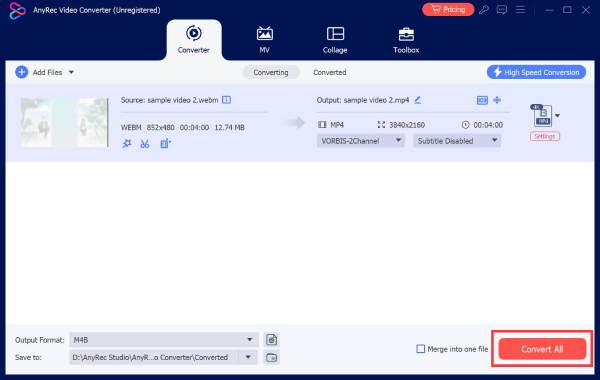
Step 1.Fire up AnyRec Video Converter on your desktop and click the "Add Files" button in the interface. Browse your local storage to choose and import the video files you want to convert.
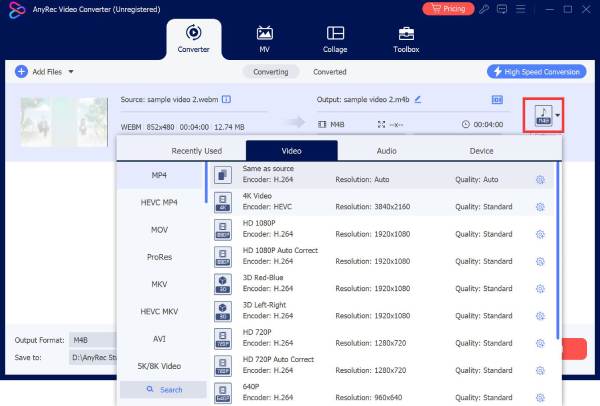
Step 2.Click the "Format" drop-down menu next to your imported clip. Then, go to the "Device" tab (or the "Video" tab and look for an iPhone format, like MOV), and choose your specific "iPhone" model or universal preset, e.g., "MP4/H.264" from the list.
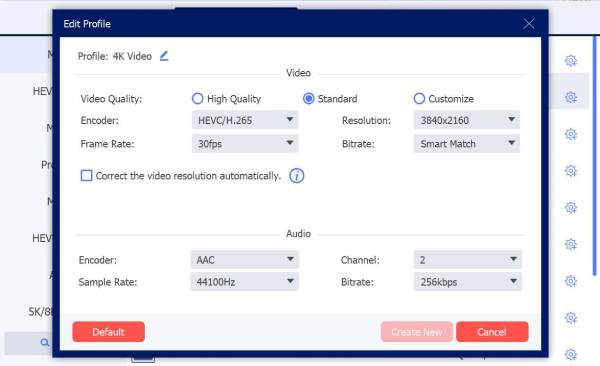
Step 3.For specific export details, click the "Custom Profile" to fine-tune parameters such as resolution, bitrate, and frame rate.
Step 4.Head down to the bottom of the main screen to select your desired saving location and rename the file. Finally, click the "Convert All" button to start the rendering process and get your file ready for iPhone.
Secure Download
Secure Download
Fix Common Problems of iPhone Video Formats
While choosing the right video format for iPhone and other settings sets a great foundation, working across various platforms can usually surface compatibility issues. Since Windows PCs, editing apps, or social media platforms handle advanced file formats differently, you might run into some playback errors when moving files off your iPhone.
The list below highlights the most common problems of iPhone video formats with direct troubleshooting steps to resolve them:
- • iPhone video won't play on Windows PC. Windows doesn't natively support the modern HEVC codec by default on newer iPhone models.
Quick Fix: Get the official HEVC Video Extension or use the universally compatible open-source player like VLC. - • Can't import iPhone Video into Premiere Pro/DaVinci Resolve. Free or older versions often have no native license decoding required to process Apple's HEVC.
Quick Fix: Update your video editing software. If it still shows an error, transcode the video into an H.264 file. (Get H.264 file converters here.) - • The iPhone video file is too large. High-resolution recording settings expand the file, eating up storage quickly.
Quick Fix: Go to "Settings" then "Camera" to "Formats" and switch to "High Efficiency". For future recordings, lower your resolution. - • iPhone video looks different on PC. Since modern iPhones capture video using HDR and Dolby Vision, older monitors interpret it as overly bright or washed out.
Quick Fix: Before transferring, head to "Settings" then "Photos" and scroll down to "Transfer to Mac or PC", and choose "Automatic". - • HEVC video won't upload to certain platforms. Older web apps and legacy forum platforms strictly mandate H.264 uploads.
Quick Fix: Convert the format using a desktop converter or toggle your iPhone camera settings to "Most Compatible" before filming.
Conclusion
You understand now the video formats for iPhone, and knowing the settings like High Efficiency and Most Compatible modes, you can get rid of storage anxiety before pressing the record button. And for those playback errors, a quick adjustment is usually all it takes to get things back on track. Also, if you somehow need to play videos on your iPhone, it is suggested to convert them to iPhone video format first with AnyRec Video Converter. This iPhone video converter does all the work without sacrificing your original video quality, making it the ultimate companion for playing your videos entirely hassle-free.
Secure Download
Secure Download
Further Reading
About Our Author