
How to Fix Pixelated Images on Any Device or Platform

Though the image looks fine on your phone, it may suddenly be a mess of blocky squares and muddy edges after opening on a big screen. A thumbnail image has too few pixels to render fine details. If you want to fix a pixelated image, you need to identify whether the damage is reversible first. Later, you can find the proper tool to make a pixelated image look sharp and clean.
Guide List
What Image Pixelation Actually Is What Causes Image Pixelation Can Pixelated Images Be Fully Fixed How to Unpixelate Images Using AI Image Upscaling How to Fix Pixelated Images with PhotoshopWhat Image Pixelation Actually Is
Digital images are made of tiny blocks, which are called pixels. Each pixel is a small square with a color. When you put millions of them together, they form a complete picture. If you zoom in close enough on any image, you can see those tiny squares. Pixelation occurs when a low-resolution image is stretched beyond its pixel count.
What Causes Image Pixelation
Pixelation rarely happens for one reason. These are the most common culprits:
- • Resizing without the right tools. If you stretch small images to larger sizes and force existing pixels to expand, blocky edges appear.
- • Over-compression. Reducing image size too aggressively strips away image data.
- • Low-resolution source files. Older cameras, budget smartphones, and screenshots don't capture enough pixel data to hold up at larger sizes.
- • Social media platforms. WhatsApp, Instagram, and Facebook automatically compress images on upload. It often significantly reduces quality without warning.
- • Wrong export settings. If you save an image at low quality or in the wrong file format, it will degrade the image.
Can Pixelated Images Be Fully Fixed
Honest answer: It depends on how bad the damage is.
- Mild pixelation: from slight compression or minor resizing. You can use AI image upscalers to handle this issue.
- Moderate pixelation: from JPEG artifacts or small source files. In most cases, it is recoverable by reconstructing plausible details.
- Severe pixelation: from very small source files or heavy compression. It is only partially fixable. AI can intelligently fill in the gaps. But some information is gone and cannot be recoverable.
How to Unpixelate Images Using AI Image Upscaling
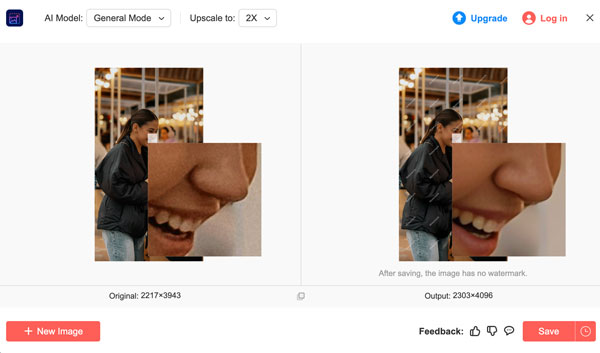
AnyRec AI Image Upscaler can also deal with pixelated photos. It is not only an online image upscaler, but also an online image enhancer that can sharpen details and reduce noise. There is no need to install anything or learn complex software.
- • AI upscale images at 2×, 4×, 6×, and 8×.
- • Use noise reduction and sharpening to unpixelate images.
- • Get two enhancing modes for general and anime images.
- • Batch upscale images (up to 50 MB each).
- 1. Open AnyRec AI Image Upscaler. Click the "Add Photo" button to import your blurry image.
- 2. Choose from 2× to 8× from the "Upscale to" list.
- 3. Hover your mouse above the image. You can clearly see the before-and-after differences.
- 4. Click the "Save" button to turn a pixelated image into a sharp, clean image for a larger display.
How to Fix Pixelated Images with Photoshop
Compared with AI upscalers, Photoshop doesn't automatically fix pixelation. But you can get more precise controls over the result. Here are 3 different tools that can sharpen pixelated images.
1. Photoshop Blur + Sharpen
It can soften the blocky edges first. Later, it recovers sharpness to get a smoother result. So, you can make your photo less pixelated.
- 1. Open your image in Photoshop.
- 2. Duplicate the layer (Ctrl/Cmd + J) to preserve the original.
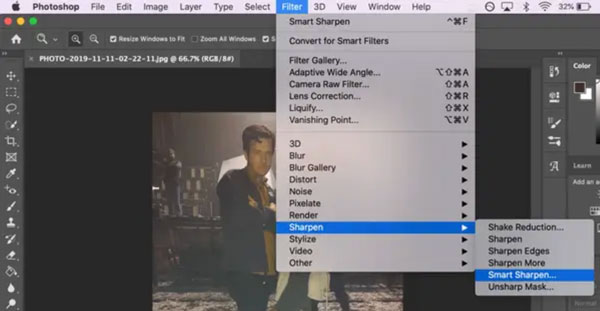
- 3. Click the "Filter", "Sharpen", and "Unsharp Mask" or "Smart Sharpen" buttons. For Unsharp Mask, try Amount: 80-120%, Radius: 1-2px, Threshold: 2-4. Adjust to taste.
- 4. Toggle layer visibility on and off to compare against the original.
- 5. If the result looks acceptable, flatten and export.
2. Photoshop Super Resolution
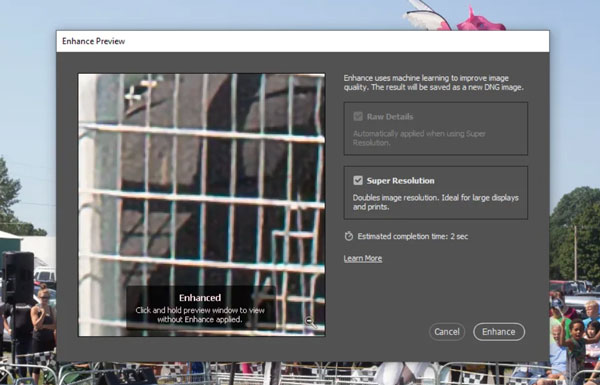
Photoshop has an AI upscaling feature called Super Resolution. You can double image dimensions while attempting to preserve edge clarity and improve image quality with Photoshop. You can use Super Resolution to fix pixelated portraits, landscapes, and textures. However, it is less effective on screenshots, graphics, or heavily compressed files.
- 1. Open your image with Photoshop.
- 2. Click the "Filter" button followed by "Camera Raw Filter".
- 3. Right-click on the preview.
- 4. Then click the "Enhance" and "Super Resolution" button.
3. Photoshop Content-Aware Tools
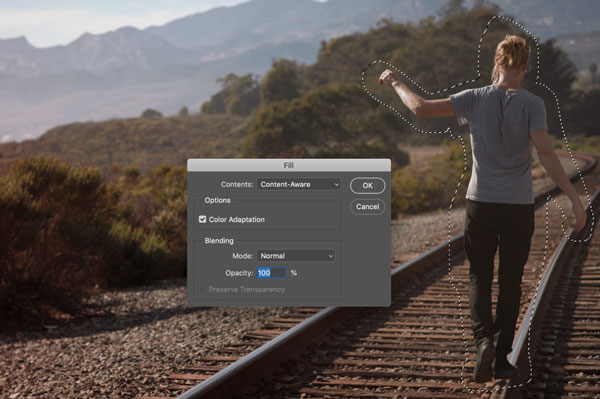
If only part of your image is pixelated (such as a face, a background patch, a cropped corner, and more), you can target the area and unpixelate with Photoshop's Content-Aware Tool.
- 1. Use the "Lasso Tool" or "Quick Selection Tool" to select the pixelated area.
- 2. Go the "Edit" list. Click the "Fill" followed by "Content-Aware" buttons. Photoshop will attempt to rebuild the selected area based on surrounding pixels.
- 3. For more controls, you can use the "Content-Aware Fill workspace" from the "Edit" list for further editings.
Conclusion
The good news is that most cases are fixable, and the tools have never been better to unpixelate an image. For quick, reliable results without a learning curve, AnyRec AI Image Upscaler handles most common cases well. Photoshop gives you more control if you have the skill and time. Whatever tool you use, the earlier you catch a resolution problem, the more options you have. Start with your best available source file, and work from there.
Related Articles
About Our Author