
Hot

AnyRec Video Converter
120× faster video conversion and editing. No waiting.
Secure Download
What Does 16:9 Aspect Ratio Mean? Size, Use, and More

The 16:9 aspect ratio is everywhere. Your TV, your laptop screen, most YouTube videos are all in 16:9 ratio. But what does that actually mean? It's simple. For every 16 units of width, you get 9 units of height. That's it. However, people may still run into problems. A video looks stretched. Black bars appear out of nowhere. An upload gets rejected. Most of these issues come down to one thing: a shape mismatch between your content and your screen. In this guide, we'll cover exactly what 16:9 means, the resolutions that use it, where you'll find it, and simple ways to convert your video when the shape is off.
Guide List
What Is a 16:9 Aspect Ratio Common 16:9 Resolutions When Should You Use a 16:9 Aspect Ratio How to Change a Video to 16:9 16:9 vs. Other Common Ratios How to Fix Black Bars on 16:9 VideosWhat Is a 16:9 Aspect Ratio
The 16:9 aspect ratio describes the shape of an image or video. It means the frame is 16 units wide for every 9 units in height. Do the math and you get a ratio of about 1.778. Any resolution where width divided by height lands near that number counts as 16:9. This is why 1920×1080, 2560×1440, and 3840×2160 all look the same shape, even though they're different sizes. In simple terms, it is a wide rectangle that is commonly used for modern videos and screens.
People often confuse aspect ratio with resolution. They're not the same thing. Aspect ratio is the shape. Resolution is the size. A video can be 16:9 at 720p, or 16:9 at 4K. Same shape, different amount of detail.
Common 16:9 Resolutions
Not all 16:9 videos look the same. The ratio stays fixed, but the resolution changes how sharp and detailed the picture is. Here's a breakdown of the most common 16:9 resolutions you'll come across.
| Resolution | Quality | Notes |
| 640 × 360 | nHD | Small file size, which is used for previews and low‑bandwidth streaming. |
| 854 × 480 | SD | Still used for slow connections or older devices. |
| 1280 × 720 | HD | Minimum for YouTube, and aging fast. |
| 1920 × 1080 | Full HD | Most common – standard for web and TV. |
| 2560 × 1440 | 2K | Common for gaming monitors. |
| 3840 × 2160 | 4K UHD | Standard for modern TVs and streaming. |
| 7680 × 4320 | 8K UHD | Emerging – rare in consumer content. |
Smaller resolutions (such as nHD and SD) are good for saving space or slow internet. But they look blurry on big screens. 1080p is the safe middle ground. A 1080p video looks sharp and works on almost all platforms. 4K is quickly becoming the new standard, especially for TVs and streaming platforms. (See differences between 4K vs. 1080p.) As for 8K, it is still mostly future-facing. Very few devices or platforms fully support 8K videos yet.
When Should You Use a 16:9 Aspect Ratio
Most screens, platforms, and devices are built around the 16:9 aspect ratio. Here's where you'll run into it most.
| Use | Why 16:9 Works |
| YouTube | Standard shape for regular videos. |
| Netflix & streaming | Common format for TV shows and online video. |
| TVs | Most modern HD and 4K TVs use 16:9 screens. |
| Computer monitors | Widely used on laptops, desktops, and external monitors. |
| Presentations | PowerPoint and Google Slides commonly use 16:9. |
| Online courses | Fit video lessons, slides, and screen recordings well. |
| Screen recordings | Match many common monitor resolutions, such as 1920 × 1080. |
How to Change a Video to 16:9
There are many ways to convert a video to 16:9 widescreen aspect ratio. It depends on your source footage and what you're willing to trade off.
| Method | What It Does | What You May Lose |
| Crop the Video | Remove parts outside the 16:9 frame. | Lose some content at the edges. |
| Resize Without Stretching | Change the video size to a 16:9 resolution. | Work cleanly if source is already 16:9. |
| Add Black Bars (Letterboxing) | Keep the full video and fills the extra space. | No content lost, but black space appears. |
| Avoid stretching | Keep the original proportions. | Avoid blurry or stretched output. |
You can use AnyRec Video Converter to make a video in 16:9 ratio with premade presets and editing tools. If you want to get full control over the conversion and fix the wrong video aspect ratio, you can solve the problem here.
Convert 21:9, 4:3, or vertical 9:16 videos to 16:9.
Crop, resize, and add black bars to make the frame fit 16:9.
120× hardware acceleration for fast processing (large 4K files).
Get 20+ editing tools to create custom videos easily.
Secure Download
Secure Download
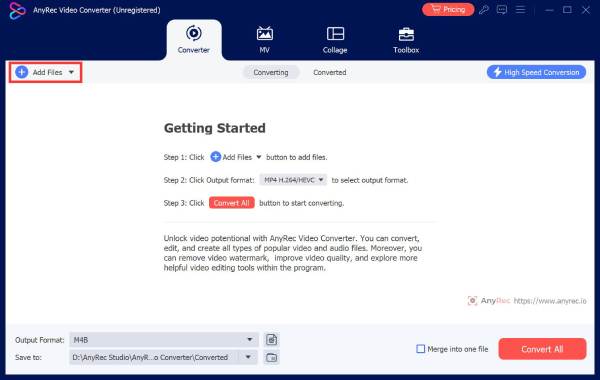
Step 1.Open AnyRec Video Converter. Click the "Add Files" button. Browse and upload your video.
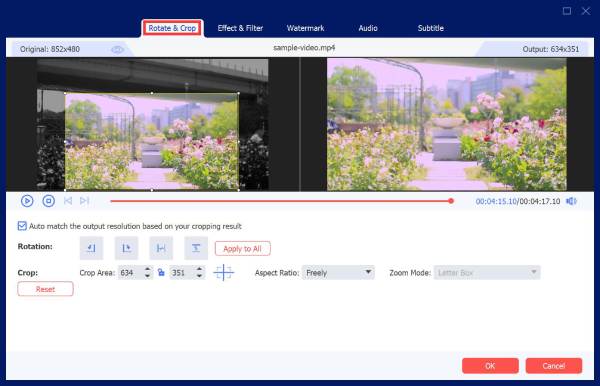
Step 2.Click the "Edit" button under your video. In the default "Rotate & Crop" section, choose your preferred aspect ratio. Moreover, you can crop the video and remove the black bar here.
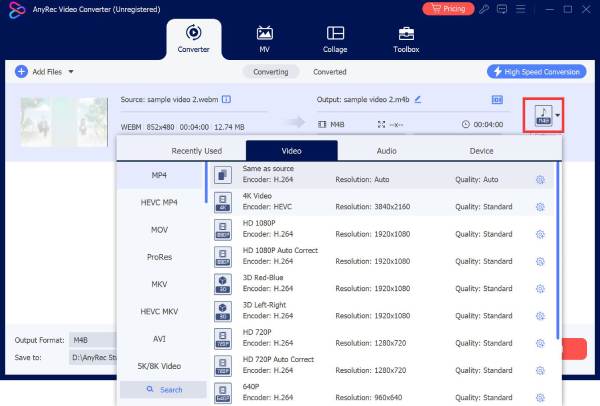
Step 3.If you want to export video in other formats, you can click the "Format" button and get all available choices. At last, click the "Convert All" button to get the 16:9 video aspect ratio.
16:9 vs. Other Common Ratios
| Ratio | Best For | Notes |
| 16:9 (1.78:1) | YouTube, TV, monitors, film | The default and widest native support. |
| 9:16 | TikTok, Reels, Shorts, Stories | 16:9 turned vertically, which fills phone screens. |
| 1:1 | Instagram feed, square posts | Equal width and height. |
| 4:5 | Facebook/LinkedIn feed posts | Take up more screen space than 16:9 in a feed. |
| 4:3 | Legacy content, retro aesthetic | TV standard before 16:9 took over. |
| 21:9 | Ultrawide monitors, cinema | Wider view, which causes black bars on 16:9 screens. |
| 2.35:1 | Cinematic film | Wider than 16:9. It creates letterbox bars on standard displays. |
How to Fix Black Bars on 16:9 Videos
Black bars are one of the most common frustrations tied to 16:9 video aspect ratios.. Here's what causes them and how to deal with them.
Why Do Black Bars Appear
| Type | Where the Bars Show | When It Happens |
| Letterboxing | Top and bottom | Content is wider than the screen. A 2.35:1 film or a 21:9 recording on a 16:9 display. |
| Pillarboxing | Left and right | Content is narrower than the screen. A 4:3 video on a 16:9 display. |
| Windowboxing | All four sides | Content is smaller than the screen in both directions. |
The root cause is simple: screens have a fixed shape, but content doesn't. Some videos are 2.35:1, some are 1.78:1, some are 4:3. No single screen shape fits all content perfectly.
Crop vs Letterbox
| Option | What Happens | Trade‑off |
| Crop | Cut off part of the frame to fill the screen. | Lose content at the edges. |
| Letterbox | Add black bars to preserve the full frame. | No content lost, but bars appear. |
Which Option Is Better
It really comes down to your needs:
- • Want a full-screen 16:9 video? Crop the extra content. An online video cropper is a good choice.
- • Want to keep everything? Add bars or padding.
- • Want to avoid distortion? Never stretch the video.
- • Want the best image quality? Avoid permanently encoding unnecessary black bars when possible.
Tips to Prevent Black Bars Before Exporting
- • Set the canvas to 16:9.
- • Set the video resolution to 1920 × 1080 or other 16:9 sizes.
- • Check the video crop area first.
- • Don't change the original proportions.
- • Preview the video and check for any unwanted black bars before exporting.
Conclusion
16:9 ratio isn't complicated. Some people may have problems with content that doesn't match, including old 4:3 clips, ultrawide recordings, or vertical phone videos. During this time, you can use AnyRec Video Converter to resize, crop, or letterbox your footage to 16:9 in a few clicks. If you're tired of black bars, stretched video footage, or rejected uploads, download AnyRec Video Converter. It can get your videos into the right shape for good.
Secure Download
Secure Download
Further Reading
About Our Author